Friday, May 22, 2009

The Fall (2006)

In Magic Realism, anything can happen. In stories told by a great storyteller, the real only disguises truth. Director Tarsem Singh shows the magic of cinema and storytelling in his 2006 film, The Fall. [Note: Some spoilers follow.]


The Fall opens with a montage of a 1920s movie company filming on train tressle bridge, pulling up from a river a horse that has died in a stunt gone wrong. We later learn that Roy (played with subtly by Lee Pace), the main character and a stunt man in the movie, has been paralyzed in the fall.


Switch to a hospital in Los Angeles “once upon a time.” Alexandria (played by charming Rumanian child-actress Catina Untaru), an unaffected 5 year old, has written a note to her nurse which she throws down to her. It ends up in Roy’s room. Alexandria, a Rumanian refugee, had fallen while picking oranges and broken her arm which is set in a rigid cast. As she sets out in the hospital, she sees an X-Ray technician in his lead protective garb [who frightens Alexandria and
becomes the prototype of Odious’s henchmen dogs]. Searching for her note, she sees Roy reading it [we recognize it because it is decorated by cut out diamonds]. Alexandria goes in to retrieve her note from him. While talking with Roy, she stands looking toward a door. Through the keyhole (like through a camera lens) an image of a horse appears. When a nurse opens the door, Alexandria is transfixed with an image of man and horse. Roy begins telling her a story about her namesake, Alexander the Great, and she immediately imagines him on a horse in Roman ruins.

Breaking into the story, Alexandria joins Roy. He looks at the contents of her treasure box, which include an elephant trinket and a photograph of her family (with her father and her horse). Roy asks her if she has stolen these things. She replies that she has found them.

As the story resumes, Roy tells Alexandria that he was wrong, that Alexander the Great had no horse and was lost in a desert with his men and no water. We see then, in glorious vista, a group of men in a vast desert. One of Alexander’s men returns on horseback. He gives him a note to read (the note has diamond shapes cut out). The man gives Alexander a helmet with water saying that it is all the water that could be found. Alexander pours it onto the sand.


“Why?” asks Alexandria. “What would you do better?” asks Roy. “I would give every soldier just a little bit.” In this their first story, some of the ground rules for the film are set up: Roy will be the storyteller, but Alexandria imagines the story based on her experiences and suggests changes in the narrative. At any point, the narrative can be intruded upon, reminding us it is only a story. Roy asks her to return when he will tell her a great epic adventure of love and revenge. [Later in the film Roy says the only the reason he is telling her the story is to get her to steal his medicine for him.]

When the doctor comes and ends the interview, Alexandria meets an old man who offers her an orange. Then he takes out his false teeth and tries to entertain her with them. Later in bed, Alexandria is studying a picture of the itinerant workers in the orange grown, including an Indian in a turban. Only five, she goes to the head nurse, Nurse Evelyn her mother substitute, to be held and comforted.

At this point, we are introduced to other characters in the hospital story, including a compassionate doctor, an African-American iceman, and Roy’s film colleagues—the man with one leg (who tells Roy that losing his leg opened up new acting opportunities—especially playing one legged pirates), the leading man who has stolen Roy’s love from him (who becomes Odious), and the leading lady who has jilted him.


Symbols of the film include Alexandria’s box of treasures, oranges, the horse, false teeth, the man with the gap teeth. Everywhere Alexandria goes she carries her cigar box of treasures—an elephant figurine she found, a picture of her father [a man with gap teeth] and family with their horse. Her box later becomes Darwin's treasure box also. The symbol of the orange is obvious. It is how Alexandria’s immigrant family sustain themselves. The horse is a little more subtle. The first image of the horse is the dead horse being lifted up from the water. For Roy, therefore, the horse represents the fall which left him paralized. When Alexandria waits to talk with Roy, Alexandria faces a door and sees a horse reflected through a keyhole onto the wall. Later in the film, Alexandria’s imagination shows us how her father was killed by men burning their house and stealing their horse. For both, therefore, it might be the tangible symbol of what they have loss… a loss which bonds them.

Roy finally begins his “epic tale of love and revenge.” Five bandits—changed from pirates because Alexandria doesn’t like pirates—exist on Butterfly Island, sent there by their nemesis, Governor Odious. The five men have all been hurt by Odious. The first is an African who has been a slave to Odious The second is an Indian who strokes his eyebrow when he thinks (seen by Alexandria as her turbaned friend from India, even though Roy talks about his “squaw”). Odious has kidnapped his wife who dies escaping him. The third, an explosives expert, has been banished by Odious. The fourth, the scientist Charles Darwin who is trying to find the goal of his life--a butterfly (interjects Alexandria), the Americanus Exoticus. Finally there is the blue bandit, who Roy makes her father, complete with his gap teeth. The men are trapped on the island because the blue bandit can’t swim. Darwin’s pet monkey tells him of an elephant swimming—and the blue bandit rides to land on the elphant’s back.


When they reach the barren land, they find a tree with a mystic who has been trapped inside. Darwin says he has birds in his stomach. The mystic leads the men to Odious’ castle. At one point, he eats their map and that map eventually reappears on his body as magical tattoos.

In the hospital story, Alexandria eventually steals some hosts from the hospital priest and offers one to Roy. “Are you trying to save my soul?” he jokes. She doesn’t understand his question. At this point, Roy has the idea that perhaps she can steal for him the “medicine” he needs to commit suicide. He asks her to steal “m-o-r-p-h-i-n-3” and when she does, she brings him 3 pills instead of the whole bottle.

In Roy’s story the Blue Bandit eventually becomes Roy as Alexandria’s love for him grows. Eventually Nurse Evelyn enters as the Blue Bandit’s love interest, Sister Evelyn, and Alexandria becomes the Blue Bandit’s daughter, who saves him from Odious’ henchmen—and ultimately from killing himself.


The film gets very dark in the last third as Roy’s depression and desire to kill himself appears in the story. One by one he kills off the characters with whom we have come to identify. Ultimately, Alexandria begs him to live. “I don’t want you to die,” she tearfully tells him, "Make him live." And in a powerful existential moment, he rejects suicide and chooses life for his character--and himself.


The film ends with the hospital and filmmaker characters watching the moving picture that Roy was in. On the screen we see a feathered headdressed Native American Indian who strokes his eyebrow when he thinks, a one legged man who has arrows stuck in his leg, and a masked bandit. At the moment that the masked bandit jumps from the train tressle, he lands on his horse and rides off. Roy’s near-tragic jump has been removed by the magic of cinema. And the film within-a-film ends with the lovers reunited. Alexandria, who has never seen a moving picture, is enthralled.

Jump forward to Alexandria well and out of the hospital, picking oranges with her family. Her turbaned friend is there. She even finds a butterfly. And she tells us that Roy has recovered and gone back to being a stunt-man. We see him do stunts and Alexandria tells us she knows it is him—doing fantastical stunts that other people can’t do. In a glorious montage, we see all these surprising stunts. He has indeed chosen life.

The film sings the power of cinema and storytelling. Gene Siskel once said that great films take us to worlds we’ve never known. Tarsem Singh, the director, filmed in over 18 countries in exotic locales which create a fantastic vision. He allows us to see the subtle love growing between his two main characters while powering our imaginations with impossible actions.


Lee Pace discusses his role:


Don't miss it!

Saturday, May 16, 2009

"Wings of Desire"

"There are angels walking among us . . ."

I collect angel artwork. I'm fascinated by how many cultures have angels images and how those images both vary and are similar. For example, I took the picture above from a bowl in the Greek/Roman collection at New York's Metropolitan Museum of Art in last month.

A few years ago, I bought some angel items that were in a collection of a young woman's estate, which included a large wooden folk art angel, a ceramic plaque with two musical angels and a modern ceramic wall flower holder. The angel with trumpet ornament is a Christmas decoration.

Other figures in my collection include a large folk art angel at top, a realistic Spanish statue of S. Raphael, a beautifully painted small hanging Russian angel, a silver/gold candle holder, plate with angel and three kings, and a modern folk angel. Above all is a framed Christmas card.

There are several movies with angels, including It's a Wonderful Life and Heaven Can Wait. In The Bishop's Wife (1947), angel Cary Grant falls in love with mortal Loretta Young.

A similar theme is developed in one of my favorite films,

The Wings of Desire (1987). [The film was remade in 1998 as City of Angels with Nicholas Cage and Meg Ryan.]

In Wings of Desire, the main character Damiel is an angel who wants to become human and experience love. My favorite scene of the film is when Damiel and the angel Cassiel walk into the public library and observes the readers sitting with their guardian angels whispering to them. I began thinking of libraries in a totally different way.


In literature, there's Elizabeth Knox's The Vintner's Luck which develops a similar theme as the above. in 1809 Frenchman Sobran Jodeau encounters an angel named Xas who Sobran determines is his guardian angel. For the rest of Sobran's life, the two develop a homo-erotic earthly relationship that goes way beyond the relationship Sobran and the reader expect.

Two graphic novels about angels come to mind.

The first, in two parts, is Yslaire's From Cloud 99: Memories Part One and Memories Part Two. In Yslaire's work, 99-year-old psychologist Eva Stern gets a series of emails from an anonymous sender with pictures documenting events in her life and the world of the 20th century and showing an angel in space who looks like her lost brother. With an assistant, she tries to decipher the messages, which seem to say that her brother is an angel--and eternal.


The second graphic novel, Murder Mysteries, is by writer Neil Gaiman and artist P. Craig Russell. A bum joins a stranger on a bench and begins telling him a story of how he is actually the angel of vengeance and how he solved the first murder of an angel. Why he is telling the story is another mystery.

Above is the angel from my Everyman paper doll set, done in the style of Albrecht Durer.

Below are more of my angel collection: first is a Balinese angel which I acquired at a garage sale. At right is a modern wooden folk African angel.

First is a 1980 Hallmark Christmas angel with lute, designed by Donna Lee; a 1997 Hallmark African-American angel with goblet; a Fontanini standing angel; large Fontanini wall angel with lute.

Saturday, May 09, 2009

Brightman and Banderas - "Phantom of the Opera"

Susan Boyle at 25 - "I Don't Know How to Love Him"

Star Trek: The Beginning

A 1995 Hallmark ornament of Captain James T. Kirk sits in front of the backdrop of the new "Star Trek" movie's bridge. Picture C. David Claudon.

Earlier this week I watched an episode of Star Trek that I had never seen, and having been a loyal viewer of the show, I was surprised. It starred Jeffrey Hunter as the captain of the U.S.S. Enterprise. I knew Hunter from his 1950s work in such movies as The Searchers and King of Kings (mocked by many as Jesus for having shaven armpits at his crucifixion). Hunter starred in the 1965 NBC pilot of Star Trek as Captain Christopher Pike, in an episode called "The Cage."

When the series was picked up, William Shatner took over as Captain James T. Kirk. That first season began in 1966, the year I began teaching, and continued until 1969, when I moved to my second job in Park Forest.

As was probably intended, after seeing the episode, I was primed to see the prequel.

Today I went to see the film and was delighted. The film had great special effects, the wit of the original, and great action sequences. The new crew pay enthusiastic homage to their predecessors. Chris Pine as Kirk and Zachary Quinto as Spock make a fun duo. I found myself laughing with the recognition of the new crew:
Nyota Uhura (Zoe Saldana), the cynical Dr. "Bones" McCoy (Karl Urban), Mr. Hikaru Sulu (John Cho) who does great action sequences, Pavel Chekov (Anton Yelchin), and the comedy relief of "Beam me up, Scotty" (Simon Pegg). Eric Bana makes a good villain. And there too is Capt. Christopher Pike (Bruce Greenwood) as Kirk's mentor and father-figure.

I saw the film on large-screen with a top-notch sound system and can urge you to run out and see it while it's still in the theatres.

If you need inspiration, check out the movie website, here and watch the trailer. The movie is as good as the trailer.

If you want to know more about the Starships, check here.


Tuesday, May 05, 2009

Joseph Campbell and the Monomyth

We all want a life of adventure, a life filled with drama and challenges forcing us to prove our worth. David, in John Connolly’s The Book of Lost Things lives a life of magical thinking. He has grown up loving fairy tales and, after the death of his mother, begins having blackouts where he is able to see a world with a castle and his dead mother calling him on a quest to save her and bring her back home.

The real world is often mundane; people live unheroic lives of boredom, monotony, and (according to Thoreau) quiet desperation. In the world of fairy tales, however, like David’s world, ivy can grown into our room trying to reach us, crooked little men can turn into magpies and appear to threaten our family, and wolves can walk upright and speak – and we can do the impossible of bringing someone back from the world of death.

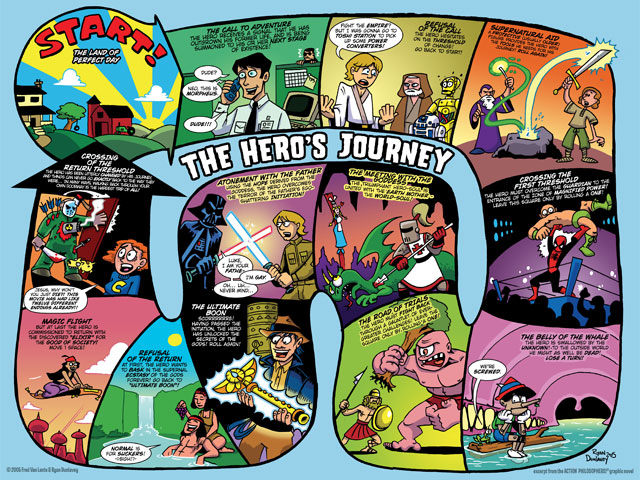
The importance of the quest. Joseph Campbell describes the pattern for all hero quest stories as “the monomyth.” He summarizes the pattern in The Hero of a Thousand Faces:
A hero ventures forth from the world of common day into a region of supernatural wonder: fabulous forces are there encountered and a decisive victory is won: the hero comes back from this mysterious adventure with the power to bestow boons on his fellow man.

Campbell then expands this pattern into various parts:
  • Separation from the Present
  • The call to adventure. The hero is sometimes thrust, sometimes enticed, into a new world.
  • Refusal of the call. Often the hero’s reponse is to refusal the call. Bilbo Baggins in The Hobbit is ultimately forced to go on the journey much against his will.
  • Meeting with the Mentor – the hero is helped by someone older and wiser.
  • Often also the hero has a companion who acts as a confidant.
  • Crossing the threshold OR
  • Entering the Belly of the Beast – some times a death and birth incident gets the hero into the new world
  • Initiation
  • Road of trials – the hero must go through a series of tests and trials
  • Mother as Goddess – often the hero must encounter a goddess figure OR
  • Woman as Temptress - the hero must resist the temptations of a woman
  • Reconcilliation with the father – the hero sometimes has to reconcile with the father-figure
  • Apotheosis – through his trials, the hero ultimately changes his viewpoint
  • The Ultimate Test or Ordeal
  • Receiving The Boon
  • The Road Back
  • Refusal of the return
  • The Chase Sequence
  • Rescue
  • Resurrection
  • Crossing the Return Threshold – Bringing Back the Elixir
  • Master of Two Worlds
  • Freedom to Live
To see how the makers of The Matrix used this, check out this video:


Here’s a visual map of the journey

Assignment: Trace how these elements are used in The Wizard of Oz or another favorite film.

Monday, May 04, 2009

Vincent at Starbucks

The Van Gogh Cover-up


A researcher claims that Vincent Van Gogh has been maligned regarding the loss of his ear.

Art history tells us that Van Gogh, in a fit of madness, cut off his ear and gave it to a prostitute. According to a new theory, Van Gogh and his friend Paul Gauguin were outside a brothel, having an argument about Gauguin's staying in the south of France. Gauguin, wielding a sword, waved it toward Van Gogh and somehow Van Gogh's ear ended up on the ground. Gauguin ran off and Van Gogh threw the sword in the river (says the researcher, to protect his friend from persecution). After presenting the ear to a prostitute, Van Gogh went home to bed. He refused to discuss the incident. Our knowledge of the incident came only from Gauguin who said Van Gogh cut off his own ear.

The friendship of the two fell apart, and seven months later, Van Gogh committed suicide.

Tsunami Hit New York?

Scientists believe that a huge wave, similar to the Christmas Indian Ocean tsunami of 2004, hit the present day area of New York City around 300 BCE. Studying more than 20 earth cores, they believe that a large storm or rare Atlantic Ocean tsunami or some space impactor could have created the findings.

Read the fascinating story here.

Sunday, May 03, 2009

Britain Indeed Has Talent

Everyone, including me, was blown away by Susan Boyle's rendering of a song from "Les Miz." Now comes Jamie Pugh to sing "Bring Him Home" from "Les Miz." Amazing.

What's Hiding in Your Cellphone?


This explains it all.

Friday, May 01, 2009

Gigapixel Imaging of Vancouver


I love Gigapixel Imaging. Click on the picture and you can almost join the people in the picture.

Tuesday, April 28, 2009

Our Tax Dollars at Work

This is old,but I laugh every time I see it--Marines in Iraq doing the Cha Cha Slide.


Enjoy.

Thursday, April 23, 2009

A Digital Abraham Lincoln

I'm from Illinois and have grown up with a deep appreciation of Abraham Lincoln. I've read a couple of books on him recently. The History Channel had a program on "Stealing Lincoln's Body," which proved interesting. In it they had a living, moving Lincoln that I thought was a well made-up actor. Surprise. This short featurette explains how they digitally created that "actor."


Monday, April 20, 2009

Has Cleopatra's Tomb Been Found?

Zahi Hawass believes so, based on some coins with Cleopatra's head, a bust, and the fragment of a mask he believes is Mark Antony because of the dimple in the chin. In his favor is the spot. While many believed Cleopatra's tomb was in her palace complex (which lies underwater now), the proposed site is some 30 miles away. I'll be interested to know more.

Embedded video from CNN Video

Thursday, April 16, 2009

Susan Boyle

She's 47, never been kissed, and currently one of the most watched people on YouTube. Susan Boyle makes me believe that it's all just a matter of finding the right moment in life. She opens her mouth and sings like a professional. You've probably already seen this, but if you haven't, here's proof that you should never make prejudgments. I end up in tears every time I see it.

Tuesday, March 31, 2009

My New Site at Imagekind


A few weeks ago I discovered a great website which allows me to post my artwork and lets people come on the site and order the artwork as prints, framed prints, cards or canvas. I've ordered lots of the cards, two large prints and one framed print and I'm delighted with the results. Check out my new site.

On a Lighter Note

What is some of the television shows of the 1980s were combined with films from the period? What if the producers of other films joined two popular ones? The concepts of these entries are exceptionally well done and made me laugh out loud.

Star Trek done as Love Boat


Star Wars done as Dallas


Brokeback of the Ring [Yes, it's what you think it is.]


Shrek 300


Pirates of the Titanic


I do love trailers--even when they are for movies that don't exist.

Hell Seen through the Eyes of the Chapman Brothers

For many years, Jake and Dinos Chapman, two British conceptual artists, have upset the established art world with their creations of sexuality, macabre images, and misplaced body parts. Their images do what few works today can do, which is shock the viewer.

Although I had known about them, I'd never seen in detail one of their works. One highly discussed work was their "Hell" (2000). This work was obviously inspired by Dante's Inferno [which I taught for years in History and Thought of Western Man]. Spurred on by the atrocities of the Nazi horror camps, the work features miniature Nazi soldiers being tortured a la The Inferno by Death's minions. The original work consisted of nine glass cases laid out in a swastika pattern.

That work was eventually destroyed in a fire. [God loves irony?] Last year, the brothers recreated it as a new work, retitling it "F**king Hell." As a miniaturist and diorama creator, I am bowled over by their vision. The film from their website is adult, disturbing and one of the most powerful artworks I've seen. Guernica by Picasso produced outrage at the brutality of the Spanish Civil War. This should do the same kind of thing. Some have called it one of the great artworks of this century.

Check it out here, but be warned it is not for more "sensitive" viewers.

Sunday, March 08, 2009

Not That Into Redux

Not too long ago, I wrote about "He's Just Not That Into You." Even funnier than that movie is a five-minute short by Kevin Connolly, Bradley Cooper, and Justin Long, on 10 Chick Flick cliches not seen in the movie.

Sunday, March 01, 2009

Lay All Your Love On Me

Forgive me. I love disco. You can tell me it's trash, but it always gets my heart pumping.

Saturday, February 28, 2009

Removing the Cyst

I don't think I've told you the story of my "sebaceous cyst" that wasn't.

It begins around 1993, after a miniature show. I was alone in a parking garage loading up our car to return home. As I put stuff in the backseat, I leaned up too quickly and hit my left temple against the door frame. After the initial hit and reaction to how much it hurt, I promptly forgot about it. I was busy, we were taking company home with us, and I didn't give it another thought.

The next morning I noticed a bump on my right temple. It kind of hurt, but I didn't remember where it had come from. At school, I dropped in on the nurse and told her it seemed a little larger than it had been and more solid and asked her what she thought it might be.

"Sounds like a sebaceous cyst," she said. "You might want to check with your doctor about it."

So I made an appointment and got in the next day to see him. He agreed with the nurse's diagnosis and told me I should come back in a week and he would drain it. Then he told me to put warm compresses on it every day--as warm as I could stand.

Well, the week went by and the cyst seemed very pronounced and hard, so I conscientiously applied the heat to it. After a week I returned to the doctor's. He said we could do the removal in the office with just a little local anathestic since it was simple procedure--not even an operation. I lay down on my side, he gave me the shot and he cut open the cyst.

I didn't like his sudden intake of air nor his "uh-oh." [Long pause.]

"Did you hit your head recently?" he asked.

"I think I did," remembering the incident in the parking garage.

"I thought so," he said. "This is a blood clot... not a cyst."

He quickly began removing whatever he had to remove and then sewed me back up.

When I told the nurse the story the next day, she blanched. "Heat is the worse thing you could do for a blood clot," she cautioned. "It could cause the blood clot to travel to the heart."

I determined right then that my guardian angel had worked dilligently during the week.

Friday, February 27, 2009

Today's Assignment


In Mary Shelley’s book, Frankenstein’s monster reads Plutarch’s Lives, Milton’s Paradise Lost, and Goethe’s Sorrows of Young Werther. These books give shape and context to the world that this child-like being is trying to understand.

Using works available now, what three works would you use to help the creature have a more successful view of the present world? [You may not use Shelley’s Frankenstein.] Give the titles and then explain in detail what the works would teach one.

Monday, February 23, 2009

What Do Women Want?


In the Wife of Bath's Tale, from Chaucer's Canterbury Tales, a knight who has committed rape is given a quest to save his life. He must find the answer to "What do women really want?" He spends a year and a day trying to find out. Eventually an old crone who forces him to marry her (but is actually a beautiful fairy in disguise) tells him that he can have her as an ugly old woman but faithful or beautiful and unfaithful. When he refuses to chose, but allows her to chose, he gets both, learning that what women really want is to make decisions of their own.

I thought of that story Sunday as I sat amid a huge audience of women in their 20s attending He's Just Not That Into You. The film pretends to teach women what men really are saying when they such things as "I'll call you." But what the film actually does is perpetuate those very stereotypes that women have come to accept:

  • The not-so hot guys are the ones you should rely on.
  • The really cute guys--who are married or in a committed relationship--are often liars and cheats. The blonde hunk, played by Bradley Cooper with a winning smile and persona, cheats on his wife, confesses to her his infidelity and then continues that infidelity while saying he wants to work it out with his wife. AND he lies about not having quit smoking, a sin the film--and wife--sees as equal to the infidelity. At the end, though, he gets his comeupance by being alone, just like the girl he cheated with and his ex-wife. [The film undercuts this high moral viewpoint toward telling the truth by having a multi-married woman say how much better she is than any of her three husbands--she was never caught.]
  • Cooper's best friend, Ben Afflick, is in a seven year committed relationship with Jennifer Aniston but refuses to marry her. He's sensitive, caring, does the dishes, but just doesn't want to do the vows. After she finally realizes that a committed relationship is better than no relationship, he gives her ring and gets on his knees to beg her to marry him. A collective sigh went up from all the romantic souls in the audience. After all, just as Sex in the City showed, what women really want is to have a man sweep them off their feet and marry them.
No where in the film is there any woman who can stand on her own without a partner. It is only as part of a couple that women are supposed to find fulfillment. Only the girl who cheated with the husband and the wronged ex-wife are alone at the end--and being alone appears a curse, not a blessing.

What do women really want? It appears Hollywood thinks it is to let men make their decisions and determine the roles to play in their lives.

Saturday, February 21, 2009

Greenfingers


I watched a most delightful film tonight with Clive Owen and Helen Mirren. Greenfingers (2001) is about a group of prisoners who are put on a gardening detail and how the experience changes them. The plot is "inspired by real events." Although it follows rather predictable lines, getting there is worth the trip. Owen has a way of drawing you in, Mirren is her usual cheeky self and David Blake Kelly plays a wry old serial killer with an enormous heart. The whole thing proved an enjoyable evening. I highly recommend it.

Trailer

Sunday, February 15, 2009

Learning from the Sunday New York Times


Part of my Sunday routine is getting up early enough to go to Starbucks and sit and read through the Sunday New York Times. On a good day, I feel I learn a lot. Today was no exception.

Among the things I learned were as follows:
  • Front page: "Unemplyment surges around the world, threatening stability"
  • There's a fascinating photo of a nattily dressed young handsome businessman beside his great car with a sign reading, "$100 WILL BUY THIS CAR / MUST HAVE CASH/ LOST ALL ON THE STOCK MARKET." The picture could taken easily today.
  • An article on Yves St. Laurent shows his book library shelves. What a great idea for a series of pictures... the libraries of friends and what they tell us about them.
  • A disturbing article by John Markoff discusses the need for a new internet since the security of the one we use has been irreparably compromised. Gangs across the world can now commandeer over 12 million computers and make them into a supercomputer called botnet.
  • Virginia Heffernan asks what makes a good Facebook update. Ultimately her answer is that questions make the most provocative updates and get the most response.
  • The book review praises Samantha Harvey's The Wilderness about a man dealing with Alzheimer's from inside his mind.
Check out the Times.

Thursday, February 12, 2009

Staging a Peter Max Midsummer Night's Dream


I am currently directing a production of William Shakespeare’s A Midsummer Night’s Dream. I’ve directed two other productions of it during my directing career, but all productions take on lives of their own.

My approach for this production is to set the play in a mythical America 1967, complete with 60s music, a couple of dances, Peter Max images, and 60s icons.

The fairies will be hippies living in the wood in a hippy van, which will be a set piece onstage. Regarding the fairies, I decided for the first time (for me) to use real wings. Oberon is a biker patterned after Marlon Brando in The Wild Ones. Theseus, Duke of Athens, is patterned on Richard Nixon, and his Amazon queen, Hippolyta, becomes Angela Davis. The mechanicals are modern workers. Bottom’s Pyramus and Flute’s Thisbe will be patterned on Sonny and Cher’s, “I Got You, Babe.” I'm currently shopping for a Prince Valiant wig for Pyramus.

Each time I’ve done the production, I have had the quandary of finding an appropriate ass’s head for Bottom that both looks good and is affordable. I spent lots of time online and finally narrowed the search down to the following two wonderful choices. Both were ordered online and arrived within a week.

The first mask is from Custom Heraldic Designs, a site specializing in numerous Medieval costumes and masks. This leather mask is expertly crafted, light weight, and is easy to wear. It is based on a Medieval manuscript illustration of mummers. It is the cheaper of the two.

The second mask, from Maskarade [630 St. Ann Street, New Orleans, LA 70116], is a beautifully crafted, much more substantial hard mask by Diane Trapp, with paper mache padded face and synthetic-fur donkey whiskers and a great tuft of black hair. This is mask we’ll probably use.

Our show will be presented during the last two weeks of March.

Monday, February 09, 2009

Post Technology


My British Lit students are currently creating blogs in a unit based on the works of Samuel Pepys. But in the last week, for two days, the internet and wireless connections at school have been down or intermittent at best. During one class I had computers in my room, but they functioned only as paper weights since no one could get online.

Today my colleagues spent our common planning period frantically trying to check mail, print up class materials (our printer is through the same wireless system as our computers), and look up things online. We all stared at the little icon indicating the computer was trying to connect, waiting for “Wireless Network Connection is now connected.” And it never came.

I realized I’m feeling the same sense of loss that I felt the day that I lost my cellphone. I realize how necessary it has become in my life to feel connected to friends and the world.

A friend drove out to Colorado to ski. He took the trip alone and when he got to the house that he had borrowed, it had no phone, no television, no wi-fi. There were six houses nearby but no lights ever came on. He had to travel eight miles for Starbucks, a newspaper and wi-fi. He described how totally alone he felt and cut off from the world. As a result, he cut his trip short by a week.

So here we are in the Age of Technology with one of its obvious flaws. One must connect with the internet in order to use it—and suddenly without it, our “global sense” disappears and we become isolated humanity.

Friday, February 06, 2009

Tuesday, February 03, 2009

What were you doing while the President spoke?


Have you seen the Gigapixel panorama shot by David Bergman?
To try it for yourself, go here.


Amazingly, with the correct viewer, you can zoom in to view a closeup of everyone in the shot.
So while we see the president speaking, we can zoom into the thousands of others. We can also see YoYo Ma taking a picture...
And the cameramen on the tower opposite the president... distant crowds listening intently... and the band sitting below the president [in detail almost clear enough to read the music].


To read about the technology required to create the shot, read here.

But the implications of the picture are very disquieting. Have we reached the technology that our spy cameras can actually pick out individuals? What might a conspiracy minded individual do surveying the crowd, looking for plots? How might we use it? How many thousands of historians will pour over this photograph making connections that we can't even imagine right now? Historians have tried to show that Booth was near Lincoln when he gave one of his inaugural addresses. What happens when we can clearly see everything from Arthea's hat to the people in standing on the buildings with weapons apparently in hand to the young woman in the white hat and black coat walking toward the stairs by section 12?


It's a whole novel waiting to be written, all documented by Mr. Bergman.


The thought sends chills of a future I'm just imaging up my back.

Sunday, February 01, 2009

25 Random Things About Me

Facebook has this exercise going where you write 25 things about yourself and then tag people who are to do the same. Since not everyone is on Facebook, I thought I would share mine.


  1. I believe that God intended each of us to be the person we are and it’s our job to figure out what that is. God didn’t create throw-away people. One of our difficulties in life is when we assume that the roles other people see for us are those that we see for ourselves. As Lewis Carroll says, “Be who you would seem to be.”
  2. I believe each day we should do something to make someone else smile. I didn’t do much politically to help win President Obama his position, but I did buy coffee for the first fifteen people who came into Starbucks that morning--and seeing their surprise and the smiles it brought was very rewarding.
  3. Each morning that I awaken and see one of my cats lying on a pillow looking out the window and another at the foot of the bed, I know the day is going to be okay.
  4. When I was in high school I read Ross Lockridge, Jr.’s Raintree County and I found myself swept into the 1840-1890 world of rural Indiana. It’s the only book that I don’t teach that I read three times.
  5. I’m sorry I can never read To Kill a Mockingbird for the first time again. Such a power affirmation of the nobility of the human spirit.
  6. I still find myself very connected to my small town Illinois roots. In many ways I find a portion of my soul responds to the Lincoln period and the people who created McLean County. A couple of branches came to that land in the 1830s and I feel I know them quite well… often better than the people I know who live there now.
  7. My grandfather was a great storyteller. I loved all his family stories. As an adult I realize he was greatly influenced by some Twain’s writing, but I thought it all came from him. He’s one of the people I strive to be.
  8. I am a social being. There are some people who help make my day positive by just taking a few minutes to have contact.
  9. I can’t escape creativity. I have to draw and paint with Photoshop, just like I had to make miniatures or direct plays. The paper dolls that I now do are a way of connecting to the Creative Muse that lives within me. When she begins urging me to work or write, I give in because I fear someday she won’t return.
  10. I’m in awe of the Facebook interface that allows all these people I know to come in contact with each other.
  11. I used to tell my classes that I was a Romantic Existentialist. I guess I still I am. I believe that there are such things as good and justice, and I believe that our actions define who we are. If we want to be good people, we have to act like ones.
  12. The most painful period in my life was separating from my wife of 25 years. I lost all the “friends” that I had. One aunt wrote me, “I will always love you as my nephew, but I never want to see you again.” Another friend wrote, “I hope you die in the gay ghetto you moved to.” It took me several years to reconcile what I thought friends were with the people I knew.
  13. Whenever I’m a little down and not sure what direction my life should take, God sends me a former student to tell me what I have meant to his/her lives. One person described the seat they sat in and the color of the room, another discussed conversations we had years before in a museum. There aren’t many professions that one can say, “I made a difference today.” Teaching is one. If you have someone who made a difference, tell them. It might make their day—and get them to smile. [I had a friend who said, “It doesn’t jingle but it feels good.”]
  14. I’ve learned that we as much out of life as we put in. Several years ago I read a book called the Drowning Room by Michael Pye, which gets its title from the rooms on 17th century Dutch ships where convicted prisoners were confined. Water could be poured into the room and there was manual pump which the prisoner had to operate. As long as they pumped, they lived. The book’s take was that that’s what our lives are like. We pump for long as we can.
  15. When I was in my twenties I went to a fortune teller who told me I was a very old soul. And then she began naming my past lives—an ancient Egyptian, an ancient Greek, a native American warrior who died in battle, a minor Elizabethan playwright, an Italian Renaissance painter, a German banker at the turn of the century who had many children—all periods that I tend to do reading on. If part of the way we know our past souls is what we are drawn to, I’m sure I died in Pompeii and on the Titanic and rode the circuit with Lincoln.
  16. I make friends with women more easily than men. Right now, I have 5 women I have coffee with each morning and 3 whom I drink margaritas with every Wednesday. They are all fascinating and I look forward to our conversations.
  17. I love to sing. I sang in high school, but by college I thought my voice had deserted me, and so for the next 30 years I didn’t sing. My best friend had me join his choir and I discovered that my voice was still there. Now I cantor at church, sing with a church choir, sing in a local acapella group of 65. There is nothing I like more than to sing for others and watch them smile.
  18. All the people in my immediate family are dead. Sometimes it’s hard being an orphan—even in your sixties.
  19. I love the spontaneity of my freshmen. I have one class where one day I had closed the door to get class started and a student walked in as the bell rang. I looked at him and said, “Hey, kids, here’s ___!” The class immediately began loudly applauding and cheering, making the student feel special. We’ve picked that up so now it’s still a bright moment in their day.
  20. I wish I were as wise as my students tried to make me. The older I get the more I realize how little I know. I’ll always been a student who relishes information.
  21. When I was a kid, I lived two blocks away from a movie theater. Every week I went to a movie, and my mother always said that I never saw a movie I didn’t like. What she didn’t know was that I just didn’t want to tell others what I thought so they could make the experience less for me. Now I go to the movie as often as I can. I can usually tell during the credits whether I will love the movie or not. During the credits of “Milk,” I was in tears for the men who were being arrested in the gay bars. In “Whose Afraid of Virginia Woof,” hearing Elizabeth Taylor’s laugh for the first time hooked me in. “Diva” opens with a concert where the African American opera singer Wilhelmena Wiggins Fernamdez sings “La Wally” and from the moment she enters—all fluid elegance with a voice to match—I knew the film was going to be special.
  22. I’m fascinated by the 1940s and 1950s. I was too young to appreciate much that went on, but occasionally I can place myself back there. Bradbury in Dandelion Wine speaks of an old man who becomes the kids’ time machine. Maybe that’s me.
  23. I don’t like to eat things that have eyes that can look at me as I eat them. The only exception is lobster, which I adore. I have to do a disconnect when I eat them, however.
  24. The triple-bypass of a few years ago forced me to think about my mortality. I hope I have a greater appreciation of life because of it. Certainly I know as long as other people remember me I’ll have a little immortality.
  25. I love the worlds that I've gained from reading. One of the worst things I went through was for three years, as I struggled with depression, I couldn't read. Reading is indeed a gift.

Saturday, January 24, 2009

Hallelujah... just read the cards

The introduction is a little off-putting, but stay with it. Handel's music will never be the same for me.

Thursday, January 22, 2009

The Battle for Christmas

During the last few weeks of the semester, I taught two works dealing with Christmas: Sir Gawain and the Green Knight and A Christmas Carol. While I was teaching the two works, I read Stephen Nissenbaum’s The Battle for Christmas, which details a fascinating history of Christmas in America. Briefly some of his information is as follows:

Mumming—costumes and masks


Nissenbaum begins by showing how the Puritans from 1620 through 1750 made the celebration of Christmas illegal. The New English Puritans objected to the drunken sense of misrule that was going on in other English areas. The Puritans recognized that December 25 was only accepted as Christ’s birth date after the 4th century. The Church at that time merely usurped the Roman Saturnalia. The early celebration varied in length, but was essentially designed as a period for workers to let off steam. Mumming, with its sense of carnival, included masks and costumes. Men often dressed as women; women as men. They selected a “Lord of Misrule.” During the celebration charity was given to the poor, with the poor going from place to place demanding drink (wassailing).

One of the signs of the conflict between Catholicism and Puritanism was the removal of “red letter days” which were the days of the saints practiced by the Roman Catholics.
Between 1730 to 1800, Christmas entered the mainstream.


Irving Creates Traditions


One author whose works helped create the sense of traditions was Washington Irving who in 1819 wrote about the celebrations at an English country manor, Bracebrige Hall. Irving admitted that he had never seen some of the traditions he described.

The Cult of Santa

The cult of Santa Claus did not exist in the Colonial Period. St. Nicholas did exist, but he was a patron saint of New Amsterdam. Irving refers to him 25 times in his writing. He is viewed as a patrician saint in a broad hat and smoking a clay pipe. On December 6, he rewards and punishes the children. A poem in 1821 refers to him as coming on Christmas Eve, traveling in a sleigh pulled by a single reindeer. In 1822 Clement Clarke Moore composed “A Visit from St. Nicholas.” He’s described a pedlar and smokes a short pipe. Gentlemen smoked long pipes; plebeians smoked short ones. St. Nick’s sleigh flew and had eight reindeer.

Santa’s transformation continued during the 1860s as Thomas Nast began drawing his Santas. His most famous—and defining image-- came about in 1881, complete with long pipe.


In Pennsylvania, the Belsnickle (from Pelz-nickle “St. Nicholas in fur”) was based on Knecht Raprecht (“Rupert the Servant”) who wore high boots, a white robe, often black mask, and enormous flax wig. He frightened people, creating mischief and demanding gifts, following in the traditions of the wassailers and the mummers.


One of the major changes of Christmas occurred in the 1800s when the poor were replaced by children.
After 1826, theatrical productions, which before were not presented on Christmas Day, became popular Christmas-fare for children.

Commercial Christmas


In 1769, a man sent mittens for his wife to a dyer. Nissenbaum lists it as the first instance of a commercial gift. By 1806 the first advertisement with Christmas presents appears in the ad of a bookseller. By 1820s Santa appears. During the depression of 1830s, more ads with Santa appeared.

The Christmas Tree


Nissenbaum explains that the Christmas tree finds its origins in the practices of German immigrants during the 1830s. In 1835 a female author describes the tree of Charles Fallen, a German immigrant Harvard professor. The top of a fir tree or spruce is placed on a table, with toys on each branch and dozens of wax candles. Traditionally the tree was not seen by the children until New Year’s Eve. An 1836 illustration shows a table top tree with fence around the base, doll house, soldiers, food and toy horse. Candles are lit on each branch. The trees probably didn’t appear earlier than 1810. In Germany they seem to have been introduced in Strasboarg after 1750.

Southern Partying

In the Antebellum South, planters took December as a season of major eating and boisterous carnival spirits including guns, firecrackers and hard drinking, a way of letting off steam. People’s drinking started before breakfast. Traditional fox hunts allowed friends to visit. Slaves could use the time to rest, sleep, travel to visit friends, attend revival meetings, even make wares they could sell. The freeing of slaves created havoc with the previous traditions. Nissenbaum’s book proved very interesting reading.

Check it out:
Stephen Nissenbaum, The Battle for Christmas. NY: Vintage Books, 1996.

Check here to see my collection of 365 Santa Clauses.

Friday, January 09, 2009

I Am a Weeper

Are there things that make you cry?


I am a weeper. Art can move me to tears.


Julia Keller, in her Chicago Tribune article, “Our Sob Stories,”
January 8, 2009, discusses how entertainment can make us cry. In an adjoining story, artists were asked what art made them cry. The two articles made me think about which artworks touch me.


THEATRE

The first work that comes to mind is Edmond Rostand’s Cyrano de Bergerac. In Act III, Cyrano wins the love of Roxane by his words as he stands under her balcony in the shadows. He—and I—weep when Christian climbs to take the kiss that Cyrano has won. In the last act, having spent 15 years visiting Roxane every week but unable to confess he was the man she loved, Cyrano comes one last time. He has been mortally wounded, but comes to her from his death bed to say one final goodbye. And as he reads the last letter he had written for Christian, she realizes that it was him that she loved. This clip, from the 1990 French film, shows the power of Rostand’s words, whether you understand French or not. [If you want to read the scene in English, try here.]


I have directed Our Town twice. During the rehearsal of the second production, my father committed suicide. The final act of the play took on special meaning as I pondered what lay beyond. Wilder sees our post-existence as a waiting, a “waiting for the non-eternal part of us to burn off.” And when Emily decides to return to view her 12th birthday, all the pain of failing to see what’s around each of us draws heavy tears of loss. Here is one production's take on that scene.


One of the most powerful productions I have seen (four times and counting) is the musical Les Miserables. Much of the production has me in tears, partially from the power of Hugo’s story of sin and redemption and the equally powerful music.
These clips, from the 10th anniversary production, move me immensely.


I Dreamed a Dream


Do You Hear the People Sing


One Day More


Empty Chairs


FILM

Movies find me an easy mark. This year’s The Curious Case of Benjamin Button, Slumdog Millionarie, and Milk all had me reaching for Kleenex.


For years I showed Katherine Hepburn in The Lion in Winter and wept at the pain she shows as Eleanor of Aquitaine losing the one man she loved, Henry II.

Then we have Titanic. With the images of the ship sailing out to sea, my fountains started and since I had read volumes about the tragedy, each nod to a real person that Cameron added, evoked the tears. From the time the ship began sinking until the end, my vision was pretty much blurred. As I was looking back at images, I find even the trailer (I have to admit MANY trailers) gets to me.


Even a parody trailer can do it. This is a sequel to Titanic I’d love to see.


When Brokeback Mountain came out I wrote here in my blog about the film. With the death of Heath Ledger, the film becomes even more poignant.


TELEVISION


Last season’s AMC's Mad Men, often brought tears—whether it was the pain of watching Joan accept the rape of her fiancé or Don’s inability to say in words the depth of feeling that he conveys in subtlities. BBC’s Torchwood had an episode where Jack meets the man he took his name from and as the two grow close, he realizes that Captain Jack has to die. For those who know the series, that episode along with the character’s relationship to Lanto moves me.


MUSIC


As a singer, I often find music touching my soul. Listen to Judy Collins sing Song for Sarajevo (I Dream of Peace).


One of the songs my choir sang at concert was Flanders Fields by Paul A. Aitken. I had to fight while singing it not to react.


Finally, perhaps it’s the Irish in me that is always moved by a well done version of Danny Boy. Here’s one done by Michael Londra from his cd Celt who gives one of the most touching versions I’ve heard of it.


What works move you?

Wednesday, October 29, 2008

Can I Have a Napkin Please?

What a great moment! A guerrilla musical (complete with wireless mikes going through the court's sound system) breaks out in a food court in LA. Improv lives.