Friday, June 09, 2006

Visiting an Old Friend: “A Prairie Home Companion”

I feel like I have just returned from visiting an old friend, having spent a couple of hours laughing, telling jokes, hearing stories, singing together, and reminiscing about old times.

For over two decades my Saturday nights included the radio show, “A Prairie Home Companion”—often as I drove stretches of Illinois’ cornfields. Many countless hours I spent enjoying the music, drawn into the homespun humor and wisdom of Garrison Keillor and his silly but sometimes pithy comment-filled adventures of Detective Guy Noir. Often, in the midst of fairly mundane patter, I’d hear some epigram of the real that would stay with me. I have remembered—perhaps incorrectly, but nonetheless—a Guy Noir story epigram, “I would rather be burnished with use than rusty from neglect.” Another time, I remember a story Keillor told of Lake Woebegone about how a dove rose up to the rafters during one of the Lutheran minister’s sermons and how everyone sat wondering if it was the Holy Ghost having come to visit them. They are stories that the imagination of radio enhances and the show became routine enjoyment for me.

I love how when Keillor’s stories are well told that they suck me into their world. Robert Altman’s new film, A Prairie Home Companion, based on a screenplay by Garrison Keillor, does just that. There are no Lake Woebegone homilies here, but the entire film becomes that extended fictional narrative where anything can happen.

Some of the musical numbers speak so clearly to some place within me that I felt transcended watching them being performed. Merle Streep and Lily Tomlin as the Johnson sisters were a joy to watch—and I found myself actually tearing up on their song about their mother and family moving on, remembering losses I've experienced also.

The movie is, after all, about death—a character dies, the show is to be killed off and the theatre is to be torn down. But the gentle spirit of Keiller keeps it from being too dark. After all, when Dangerous Woman wears a white trench coat “molded so tightly to her body that you can read her underwear,” humor staves off any fear of that Great By and By. Dangerous Woman says not to mourn the passing of an old man but rather rejoice in what he brought you. Is that any different than Emily in “Our Town” asking us to look at what is passing from our lives and hold on to it as long as we can? As the credits began, I felt good about myself… good about the film… good about life.

The music is one of the first reasons to see the film. I’ve already mentioned my admiration for Streep and Tomlin. The singing cowboys Woody Harrelson and John C. Reilly offer two great specialty songs, and even Lindsay Lohan proves that she can belt out with the best of them. The rich husky gospel voice of diva Jearlyn Steele makes you want to join in at the end when she calls you to sing along. I wanted to… I wanted to clap and stomp my feet, but waited to applaud enthusiastically with the rest of the audience at the end.

Watching Altman’s films from McCabe and Mrs. Miller (1971) up to now, I’ve come to expect the characteristic ensemble acting, the overlapping speeches, the improvisational feel, but I don’t recall any film of his capturing the warmth and affirmation of life that this one does. Perhaps when Altman had his heart transplant 11 years ago, he learned how to share what is important with us.

Like Altman who is perhaps investigating his own mortality and Keillor who is investigating the end of 32 years of performing his radio show, I find myself past a triple bypass and the closure (perhaps) of 39 years of teaching. Like Meryl Streep’s character, I want to continue doing farewell tours for long as I can remember the lines. …And this movie helps me realize that goodbyes don’t wipe out the good memories. And sometimes just being and doing and enjoying for as long as you can is enough.


For Altman observations on the film check out below:

Sunday, June 04, 2006

Otto Wagner

At a garage sale yesterday, I found this lovely print of the work of Austrian
Art Nouveau architect, Otto Wagner. Labeled "Galerie fur Werke der Kunst Unserer Zeit" [?Gallery for Art of Our Time], it has wonderful Art Nouveau murals running across the front of the building. They would have been spectacular. I can't find evidence, however, that the piece was more than an academic piece.


I was delighted to find this framed poster--approximately 3 feet wide-- for only $10. The frame alone would have been 10 times that. But it also prompted me to learn more about Wagner's work.

According to information online, Wagner was part of the Vienna Successionists, which included Klimt (of the famous "Kiss") and Hoffman. Wagner has some beautiful designs. I am particularly taken with his three-dimenstional model of the Imperial Entrance Hall of the Academy of Fine Arts of Vienna (1898).


Wagner's poster is a great addition to my office wall.


For more information on Wagner check out:

Tuesday, May 23, 2006

Goodbye GSA

Today I attended my last meeting as sponsor of Rich East's Gay/Straight Alliance. We've had a turbulent history and remain the school and district's "unofficial" club--they let us meet and function as a club but the sponsors are unpaid. But that doesn't matter. What matters is the kids can meet and feel safe.

The GSA began in 2002 as a result of District 227's Multicultural Committee's work on helping gay students. A small committee grew out of a second summer teacher's institute which dealt with training teachers to be more sensitive to the needs of gay students. Ultimately I was selected to be sponsor with Katie Stadt as my co-sponsor.

One of the statements a gay young man at the workshop said was that in his entire education no teacher had ever spoken favorably about a gay author or artist or athelete. "Don't deny us our history," was his empassioned summation.

To learn more about creating the club and the kind of student I would be supporting, I attended a conference that July called Sexual Minority Youth in the Heartland: Issues and Methods for Youth-serving Professionals, at Indiana University, sponsored by the Indiana University Gay, Lesbian, Bisexual, Transgendered Student Support Services. The two-day conference covered such topics as Theories of Sexual Orientation; Safe Schools, Safe Kids, Safe Teachers; Serving Gay Teens at the Library; Cultivating Leadership Skills in GLBT Youth. Former Surgeon General Dr. Joycelyn Elders gave the key-note speech on “Leave No Child Behind: Let’s Get Serious.”

Our first meeting began with five students and six adults. The biggest issue on the kids' minds was the need for a safe school environment for all students, especially gays. The structure for the meetings was established and included: snacks, a sharing of concerns, then discussion of things the club is working on, and finally, a history lesson. Students were assured from the beginning that this was an environment where they could feel safe with any issues.

Eventually the club came up with their purpose:

  • to create a healthy, supportive environment for gay, lesbian, bisexual, transgendered, questioning and straight students and staff;
  • to increase physical and emotional safety for GLBTQS students and staff;
  • to value and affirm GLBT history and provide educational resources for the Rich East community through text, technology, and teaching;
  • to have lots of fun.

In September the students participated in the AIDS walk/run in Chicago. The safe school issue became a political football in January when the school board voted to take down rainbow stickers teachers had placed on their doors to designate "safe zones" for students. Contentous public meetings only emphasized the need for protection of gay students rights. Many of the civic minded students rallied against what they preceived as an injustice and by the end of the year we had had 30 students attend the meetings. The club won the Student Council's Outstanding Club Award--which they've done every year since.

The students elected to designate the rainbow triangle as their official club logo.

The GSA meets every Tuesday (with the exception of the two weeks before a play production). The students remain politically active and have done not only the AIDS walks but The Day of Silence also and displays at the Village Hall during June. While they have learned that often the system doesn't give them what they want, they have also learned to work to change that system.

I'm proud to have been a role model in the process. I had to fight back a lump in my throat as they left.

Monday, May 22, 2006

Facing Retirement

I am retiring from 39 years of public school teaching this Friday, May 26, 2006. It’s a daunting thought to leave Rich East, which has been my teaching home for 36 years. I still believe I have years of teaching to go, but my daily commute involves an hour drive twice a day. Needless to say, the wear and tear on my body and my car is considerable. And after 11 years of it, I need to move into a new phase of my life.

Among the students I teach were seniors who were also facing this expulsion from the womb with a view with trepidation. The last day of class I gave them my words of wisdom… what I’ve learned in the process can be summarized in the following ideas:

Man is a sum of his actions. So say Sartre and Camus in defining existentialism. It is our actions which make clear who we are, not our dreams nor our thoughts. I tell the students a story I read sometime in the distant past (I think it was by Guy Du Maupassant, but don't hold me to it). In the story, a man knows his soul is black, something others would not like. So he dons a mask in public and wears it all the time. The mask is that of a man of virtue—and he goes about doing good constantly, but he know that in his heart he is not. He never takes the mask off. When the man dies his mask is removed—and his face has become the mask. His actions made him who he was... and the man of good was so because he acted like a man of good.

“Acceptance on someone else’s terms is worse than rejection” (Mary Cassatt). For years I spent my life trying to be who others wanted me to be—and the most common feeling I had was discontent because of it. It was not until I broke with my past and began living on my own and accepting who I was that I could really appreciate Cassatt’s advice.

Life is all about change. The world we inhabit changes constantly. As Samuel Beckett says—it oozes and it flows. We sluff off layers of skin; the sun changes position; and the rocks get worn away a little bit more. Relationships daily redefine themselves. And we move forward because that’s the only direction we can go. If we’re lucky, we can smile in the process of following that move.

So when I say goodbye to the room which has been my strength for the last 14 years and the students which have sustained me for much over twice as long, I hope to move on with a sense of awe and wonder at this new chapter in my life.

Sunday, May 07, 2006

Guardian for a New Millenium

Guardian for a New Millenium by David Claudon
Here I was playing with Photoshop CS2, using layers and brushes and a vintage photograph from my collection.

© 2006, David Claudon.

Young Englishman, ca 1890


This portrait uses both Corel Painter IX and Photoshop CS2. The portrait is based on a cabinet card from around 1890. On the back of the card was an advertisement for artist/photographer George Stone, 72 Baron St, Gloucester, England.

© 2006 David Claudon.

Medieval Mourner Pastel Digital Painting

Last year, I visited my friend Jon in New York and we visited the Metropolitan Museum of Art. One of the pictures I took was of this Medieval Mourner statue from around 1450. Experimenting with Corel Painter IX and using Martin Addison's book, Painter IX for Photographers, First Edition : Creating Painterly Images Step by Step , I made this pastel of the picture.

© 2006 David Claudon

Monday, May 01, 2006

Family Album: Britiannia Bray Van Dolah

Britannia Bray Van Dolah My great-great maternal grandmother, Britannia Bray Van Dolah, was born in 1841 in Spencer County, Indiana. In 1853, her father moved to McLean County, Illinois, and proceeded to outlive three wives. Besides farming 160 acres in Martin Township, he taught in a country school.

In 1864, Britannia married Lexington livery and live stock businessman David Hyatt Van Dolah. He supposedly (according to family tradition) had recently paid his brother $300 to fight for him in the Civil War. Britannia and D.H. became doting parents of two sons: James Walter (1865-1936) and Lewis Sheridan "Tad" (1867-1919).

In 1868, D.H., Ike Harness and others founded a bank in Lexington (Harness, Vandolah & Company). As a banker, Van Dolah was a shrewd businessman and amassed a fortune buying and selling land both in Illinois and Missouri. A one point he was said to have owned 2,000 acres in McLean County.

D.H. Van Dolah & Tad From 1878 to 1889, Van Dolah imported French Percheron and Norman draft horses, going to Europe seven times (his wife two). In the picture at left, D.H. is the one with the long beard, while his son Tad lies rakishly at his feet.


According to family tradition, during one such trip D.H. brought back three large diamonds hidden in feed sacks. (Each of my siblings and I inherited one of the diamonds.) It is told that another gift brought from Europe was a beautiful large music box which plays about 8 tunes. The box was a gift for one D.H.'s tellers, Hop (William Hopkins) Kennedy, who had become son James' father-in-law in 1887. (I still own the music box.)

Having traveled abroad, D.H. preferred French crepes for breakfast. One morning "Sis" (as D.H. called her) served him regular pancakes. He stormed out of the house and got in the buggy and began riding around in a circle feeding the pancakes to the pigs. "He was a Tartar," laughed my grandmother, telling the story.

In France around 1897, Britannia admired the French chateau and decided she wanted her husband to build her one. During 1897-1898, the new house--known in Lexington as the "Castle"--was built. Located just west of Lexington the house was the work of Pontiac contractor C. W. Mathewison. Estimates placed the cost of the house between $35,000. and $80,000. Payrolls showed workers earned from 15 to 25 cents per hour. Scaffolds were not permitted to go up outside the house, so they were only used inside the structure.

The 30 room structure had a double-wall constructed of Indiana limestone, Maine granite and Missouri buff brick. The roof was slate.

The house consisted of four stories, complete with a circular oak stairway leading up to the fourth floor grand ballroom. The entrance hall chandelier was brass and custard glass.

According to a news article, "English flocked wallpaper and a pecky cypress ceiling decorate the south drawing room. Special supports were installed for the 300-pound chandelier from a French chateau." The dining room had a Belgian chandelier.

The castle tower contained two round rooms, one used as a study. The second room was a bedroom.

The house was said to have one of the first working elevators in McLean County.

In January 1903 at aged 61, D. H. Van Dolah died of a heart attack.

Britannia on an alligatorBritannia outlived her husband by 27 years, remaining the dominant matriarch of the family throughout. She traveled yearly, but was plagued with ill health the last few years of her life. At right she can be seen on one of her winter trips to Florida around 1912. She sits astride a stuffed alligator. To her right is Ella Kennedy Van Dolah, her son James' wife.

Britannia was 89 at the time of her death in 1930. Said her obituary in 1930:

During the days of her robust health she was a leader in the religious, educational and social affairs of Lexington. She was a member of the Christian Church, the Order of the Eastern Stars and a charter member of the Lexington Woman's Club.

The Van Dolahs are buried in a family section of the Lexington Cemetery (originally known as the Porteus Cemetery). Standing at Britannia's tombstone you can see the house she had her husband build up on a hill to the south-east.

Colorized tintype of Britannia Bray Vandolah, ca. 1868 © 2006 David Claudon. "Castle" picture from Lexington Unit Journal.

Saturday, April 01, 2006

Family Album: My Father Dancing


Ivan Claudon


Yesterday I happened upon an internet article written by one of my parents’ friends about the Turkey Creek Golf Course, created in March 1922 on land of my great-great grandmother in Lexington, Illinois.

It was interesting to see my grandfather Charles Carnahan (then 25) as one of the founders since I didn’t know he played golf. I knew that my parents (and brother and sister) loved golf, but not my grandfather.


What I found even more surprising, however, was the following:


When the club house was vacated, the area teenagers took it over and held dances there. Ask Ivan Claudon about the Saturdays he spent cutting logs to burn in the fireplace to provide heat for the building. He still claims to have had enough energy left to spend the night folk or square dancing to records. Harold Siron recalls an occasion or two when Emmett Douglass played fiddle and his wife accompanied on the piano. The hills became a popular spot for winter sledding.


Ivan Claudon was my father. I never knew he enjoyed dancing. I can only vaguely recall seeing him dance once at my sister’s wedding. The above description speaks of a person I never knew.

My father, at the age of 64, committed suicide on Monday, 21 April 1980. Early that morning, he left the ranch-style home my parents had built across from my grandmother’s home. He drove a little over a mile to the barn he had planned to renovate into a retirement home, on property inherited from my grandmother—near the site of the Turkey Creek Golf Course—and then he hanged himself. He had just retired, and he lost a battle with clinical depression.

Depression runs in my father’s family. In the 1930s, his father had been committed for a brief time to a mental institution for being a “spend-thrift” (he bought a race horse and my grandmother saw this purchase at the height of the Depression as signs of a certifiable illness). My father, even though he wasn’t the oldest son had to sign papers for the commitment. I understand now that he always feared he might suffer the same fate. I understood what he had gone through even more fully when I fought my own battle with clinical depression in the 1990s.

My father kept a lot inside. His viewpoint was clearly shown when my mother’s father died. He approached my brother and I and told us not to cry because it would only upset my mother even more.

Before I did the Thornton Wilder digression, I was trying to reconcile the picture of the father I remember with that young man who chopped wood and danced the evening away. We were cut from the same mold and I didn’t even know it.

For much of my youth, my father and I butted heads. It didn’t help that I wanted to go into art and theatre. My father was an electrical engineer, a practical man. Only much later did I realize that he enjoyed the things that I did. But that was after I had married and settled down to teach. Two days before his death he paid a visit to my home in Park Forest. He pulled me aside at the end of the visit and told me he was proud of me. I had a great home and seemed happy. He was saying goodbye.

After reading the article, I’d like to imagine him with me on one of those club nights I used to have when I first moved to Chicago. The two of us going clubbing, having some drinks, and dancing the night away—I could have enjoyed that.

Wednesday, March 01, 2006

Delta 32


Medieval doctors wore bird-like masks to protect themselves from deadly vapors. Aromatic herbs were placed in the beak of the mask.


According to yesterday's news, the deadly strain of bird flu [H5N1] had been confirmed in a cat in northern Germany, "the first time the virus has been identified in a mammal in the 25 nations of the European union." I pondered what that news might mean as we dealt in my History and Thought of Western Man class with the Black Death.

We showed a PBS film, Secrets of the Dead: Mystery of the Black Death, which examines the mystery of why, when the Black Death came in 1665 to the English village of Eyam, half the people were able to survive. According to the film, with the first deaths, the villagers turned to their rector who suggested the entire town be quarantined. The surprise was that rather than everyone dying, at least half the people of the village survived.


To find an answer as to why they survived, scientists examined the DNA of descendants of the survivors and found that 14 percent possessed a recessive gene mutation called delta 32. Testing the distribution of this gene throughout the world, they discovered none in native Africans, East Asians nor Indians. Research established that the gene is only found in those regions of Europe where the Black Death hit and in America which is where some European descendants moved.

But that’s not all. Noting that the Black Death was a disease that attacked the immune system, researchers began wondering if there was a link with other immune diseases. Scientists looked at the case of Steven Crohn, an actively gay man whose partner was the fifth person to die of AIDS in America. Crohn did not contract the disease. Most of his friends died from AIDS, and he certainly was exposed to the virus. DNA tests showed he did indeed possess the mutant gene, which doesn’t allow the AIDS virus to attack the immune system. Surprisingly Crohn not only had not gotten the disease, he may never get it. And he may be among thousands who have the same immunity.

The gene has been around a long time. Researchers have discovered Scandinavian bodies pre-Black Death who possess the gene.

While the discovery of delta 32 offers tantalizing areas for researchers to study, it does point out how survival of Black Death or of AIDS may be the luck of the gene pool. Perhaps the same may be true with the pandemic predicted with bird flu.

For more information, check out:

Saturday, February 25, 2006

After Brokeback


I have seen Brokeback Mountain three times and wept each time. I have read the short story and the screenplay and wept at each. I guess that makes me a weeper.

Having seen the movie when it first came out, I wanted to write about it but found myself inarticulate in describing why the film is so powerful to me. A friend asked, isn’t that inability to speak about what is important one of the points of the film?

For me the story speaks about our American Puritan ethic of denial. Rather than allowing himself to deal with “this thing that takes ahold of us,” Ennis denies it, refuses to name it, hides it away from view, eventually mounting it as a shrine to what he has lost. For a love story, it’s amazing that love is never mentioned.

Annie Proulx in Brokeback Mountain: Story to Screenplay says that the story is really about destructive rural homophobia. [130] Published first in The New Yorker in October 1997, the “gay cowboys” story includes the possible hate-murder of Jack, which in turn eeirily foreshadowed the brutal October 1998 murder of Wyoming student Matthew Shepherd, something Proulx talks about in her essay “Getting Movied.”

From 1997 to 2004, Larry McMurtry and Diana Ossana wrote the screenplay, fleshing out the characters of the wives and children, and spent almost seven years trying to get it into production.

It’s interesting to watch the “Brokeback” phenomena grow and take on a life of its own. According to LOGO, “Brokeback” has become synonymous to “gay” (as in “that’s so Brokeback”). One site, youtube.com, has a series of videos either parodying the film—as in Brokeback to the Future—or ones using footage from the film. One of the most touching is one using footage but substituting Garth Brooks’ “Shameless.” It offers an interesting perspective of both.


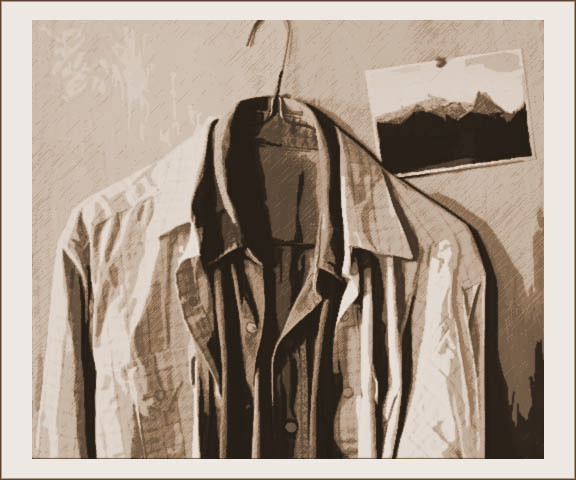
sepia shirts

Last week the two shirts that were major symbols in the film were sold at auction for $101,100.51. The buyer referred to them as “the ruby slippers of our time.”

The shirts are perhaps one of the most potent symbols of the story/film and a friend who has seen the movie twice surprised me by not remembering them.


In the story, Annie Proulx allows Ennis to find the shirts, realizing first that it is Jack’s old shirt with Ennis’ blood on it, and then in the next paragraph that his own plaid shirt that he thought he’d lost is carefully worked down inside Jack’s sleeves.


…Stolen by Jack and hidden here inside Jack’s own shirt, the pair like two skins, one inside the other two in one. He pressed his face into the fabric and breathed in slowly through his mouth and nose, hoping for the faintest smoke and mountain sage and salty sweet stink of Jack but there was no real scent, only the memory of it, the imagined power of Brokeback Moutain on which nothing was left but what he held in his hands. [26]

Later, beside a postcard he gets of Brokeback Mountain, he drives a nail in a corner of his trailer and on it hangs the wire hanger and the two old shirts suspended from it. [27]

What I find fascinating is seeing how the symbol was reworked by the screenwriters:


And there, on the back of the closet door, WE SEE THE SHIRTS, on a wire hangar suspended from a nail, and next to them, a postcard of Brokeback Mountain, tacked onto the door. He has taken his shirt from inside of JACK’S, and has carefully tucked JACK’S shirt down inside his own.

He snaps the top button of one of the shirts. [97]

When Jack takes the shirt, he hides Ennis inside his shirt, just as he hides him inside himself… and in the film, we see that Ennis has finally understood and done the same. He says, “Jack, I swear,” but as Annie Proulx writes in the short story, “ though Jack had never asked him to swear anything and was himself not the swearing kind.”

Whether the film will win the Academy Award next Sunday as Best Picture, it has already won that title from the New York Film Critics Circle, British Academy Film Awards, and Directors Guild of American Awards. It has already etched itself into my life and my experience. For me, it was the best picture I saw last year.


Bright Lights Film Journal offers two contrasting articles on Brokeback Mountain:

John Scagliotti offers an interesting perspective from a gay man's viewpoint in Why There Are No Real Gay Men in "Brokeback Mountain."

Tuesday, February 14, 2006

A Reading List

The following is a partial list of some of the books I have read since last summer.

Saturday, February 04, 2006

Appendicitis at 62

One friend writes, "You're soon going to run out of organs to be operated on just to miss school."

Tuesday night I started the hour-long drive from school to home feeling fine. About half-way home I began feeling sick to my stomach--which for me usually indicates abdomen pain. I've had a couple of bouts during this school year where I thought I'd been hit with food poisoning, spent a day in bed and finally felt better within two days. I asked the nurse at school if it could be appendicitis and she assured me if it was it wouldn't go away. Plus we all know that's something young people get--not old.

Well, back to Tuesday. I came home, went to bed and hoped that I could sleep off whatever I was feeling. About an hour later I was hit by a 10 pain in my lower right abdomen. I couldn't find a comfortable position and ended up lying face down on the bathroom floor tiles hoping it would pass. I wanted to vomit, but didn't feel like I had the energy to get up. After about 20 minutes I suddenly had this feeling that since I live alone, I didn't want people to find me on my bathroom floor. By that point the pain had gone to about 9 and I was able to get dressed and walk out to my car. I drove to my friends Vic and Janet and asked Janet to drive me to the hospital--I didn't want to be alone or would have taken myself there.

We sat in the emergency room waiting room and then the ER from 8:00 p.m. until 3:40 a.m. when they finally decided it was indeed appendicitis. The operation showed that the appendix had perforated. (Thoughts of people dying from peritonitis flashed through my head, but I decided to trust modern Science and God.)

Three days later I'm walking around, changing my own dressings and hoping that it all will heal quickly.

My reason for writing this is to remind you that if you have a pain in your lower right abdomen and it's nowhere else but there and it reaches a 10 in pain... you just may have appendicitis. I'm proof it can go away and come back, but if it had ruptured the other two times, I may not have been so lucky.

"The New World": just another world of lies


The picture at left is based on an engraving which had been made from a sketch taken from life in 1616 of the 19 year old Indian princess by Simon Van de Passe, published by Captain John Smith in 1624.

As I got up to leave the theatre showing The New World, an old man turned to his wife and said, "So whose story was that supposed to be?" "Pocahontas," explained the woman. "Really? Is that what really happened to her?" "I guess, but you know Hollywood."

In many ways the new film is as much fantasy as Disney's cartoon version. "Let's make a love story of these two people... Forget the facts--love stories sell," I can imagine some pitchman saying to the money men.

So change the facts they did. The first and most important one is that according to Camilla Townsend in Pocahontas and the Powhatan Dilemma (2004) , Pocahontas was only 10 years old (!!) when she was supposed to have saved the life of Captain John Smith. And that famous life saving moment may not have actually happened since it only appeared in Smith's reinvention and much later retelling of his own history in the Virginia colony of Jamestown--eight years after Pochantos' death.

The real story of Pocahontas is fairly simple. At around 10 she meets Captain Smith. They spent some time together and she helps him learn her language and she his. Later when he writes about her with erotic undertones, he changes her age to 15. Her name means "Mischief" and is a child's name--not what she considers her real name (Matoaka). She loves to do cartwheels and challenges the English boys to compete with her. She also becomes for two years a favorite of the Jamestown settlers.

Around the age of 15 Pocahontas marries for the first time an Indian warrior named Kokoom, who disappears from her life within a couple of years. She is taken prisoner by the English who plan to use her as a hostage against her father. She is converted to Christianity, baptized Rebecca, and marries an English widower named John Rolfe. [Rolfe had married an Englishwoman and together they were shipwrecked near Bermuda as they came to Virginia. Shakespeare uses that shipwreck as the basis for his The Tempest.] Together they become farmers of tobacco and have one son named Thomas. When Thomas is only around 1, the Rolfes go on a business trip to London, bringing along several of Pocahontas' people. There she is a social success, but she succumbs to the British germs and eventually dies as they start their journey home. John has to leave Thomas in England and never sees him again. John marries another Englishwoman and has a daughter. After his death, Thomas comes to America and inherits a great deal of property.

There is a meeting of Pocahontas and John Smith during the visit to London, but during it she berates him for having abandoned promises he had made to her father. Certainly it was not a bittersweet love farewell.

The filmmakers achieved very interesting historical mise-en-scene, but the story becomes a rather Roussean concept of "let's run in the forest with the naturals and find Paradise... but I'm not worth Paradise... etc." Colin Farrell has generally been an interesting actor (although he was absolutely awful in Stone's Alexander), but he progresses into his nature scenes, as he gives up the armor for beefcake tattoos, he attains the charisma needed for this sexual adventurer. (Block out of your mind that the girl he's seducing is only 10 in real life.)

The real knockout of the film, however, is Q'Orianka Kilcher as Pochantos. She is eloquent in her silences and speaks volumes with her eyes and gestures. Every scene with her takes life and succeeds. As a story of love lost, moving on, and letting the past go, she reminds me of Ennis in "Brokeback." She, for me, is worth the price of admission. The film itself is overlong and at times grates, but Kilcher redeems it.

So if a film successfully reproduces the look of the period but is essentially based on lies, how can one accept the veracity of any of it?

Monday, October 31, 2005

The Angel's Farewell

The picture at left is based on a sketch by Dante Gabriel Rossetti of angel and knight.

As my church choir gets ready for All Souls Day, we are practicing The Guardian's Farewell by David Haas, which utilizes the last lines of John Henry Newman's 1865, The Dream of Gerontius.

All of us are touched by the power of the poem. Although Haas has made some modifications, what follows is Newman's text.

Angel’s Farewell

SOFTLY and gently, dearly-ransomed soul,
In my most loving arms I now enfold thee,
And, o’er the penal waters, as they roll,
I poise thee, and I lower thee, and hold thee.

And carefully I dip thee in the lake,
And thou, without a sob or a resistance,
Dost through the flood thy rapid passage take,
Sinking deep, deeper, into the dim distance.
Angels, to whom the willing task is given,
Shall tend, and nurse, and lull thee, as thou liest;
And Masses on the earth and prayers in heaven,
Shall aid thee at the Throne of the most Highest.

Farewell, but not forever! Brother dear,
Be brave and patient on thy bed of sorrow;
Swiftly shall pass thy night of trial here,
And I will come and wake thee on the morrow.

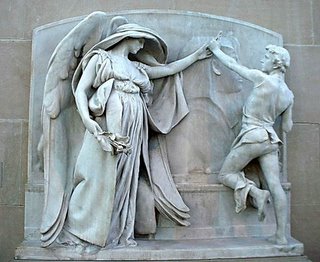
Daniel Chester French, The Angel of Death and the Sculptor, 1889

Tuesday, October 25, 2005

The Magic Realism of Louis de Bernieres


I am currently reading Louis de Bernieres’ The Troublesome Offspring of Cardinal Guzman. From the back cover’s description of the book, I figured it fit the “magic realism” category, which is a much debated category. Since I had not read much South American writing [other than Jorge Borges], I thought the book sounded interesting.

If you are not aware of the term "magic realism" this quote from http://www.themodernword.com/gabo/gabo_mr.html might help:


Literature of this type is usually characterized by elements of the fantastic woven into the story with a deadpan sense of presentation. The term is not without a lot of controversy, however, and has come under attack for numerous reasons. Some claim that it is a postcolonial hangover, a category used by "whites" to marginalize the fiction of the "other." Others claim that it is a passé literary trend, or just a way to cash in on the Latin American "boom." Still others feel the term is simply too limiting, and acts to remove the fiction in question from the world of serious literature.


De Bernieres' book is structured into fairly short chapter vignettes told by different narrators and with different perspectives. The book chronicles the people of Cochadebajo de los Gatos, an Andean village where everyone reads books and has pet jaguars, a 300-year old man can pass through searching for the beast who is a shape-changer, a Conquistador can be brought back to life from being frozen in ice and end up living in the same town as his descendant, the people can construct Utopian projects, and the oppressive Church and State can constantly intrude on the lives of its peaceful natives.

The more I read, the closer I find De Bernieres to the world of Voltaire’s Candide. Cochadebajo is a modern El Dorado whose people are threatened by the bigotry and insensitivity of both Church and State. Just as in Candide, where a noble black slave can lose his limbs for trying to escape, here a woman who has actually spoken with the Virgin Mary [who tells her to stop overdoing it with the rosary and Hail Marys] can be persecuted and eventually martyred because of two condescending missionaries.

For me, one memorable vignette is a theological lesson taught by a defrocked priest [who can magically levitate as he preaches] about the creation of man. According to his story, Satan was the creator of the world, not God. God, he maintains, would not have created something as flawed as the world. So Satan sets about to populate his world by forming people out of clay. But he can’t animate them. God sends down his Angel Adam to see what Satan is up to. God warns Adam not to go to sleep or Satan will take his soul. Of course, that’s just what happens. So Satan takes the soul of the Angel Adam and puts it into the clay, making the first man. God then sends the Angel Eve down to check on Adam. She also loses her soul to the clay. So according to De Bernieres’ priest we all have the souls of angels inside of us struggling to escape here and return to Heaven where we belong. Don’t we all sometimes feel those wings pushing to get out?

If you liked the irony and wisdom of Candide, if you like a world where the magical can coexist with the mundane, if you are willing to think, you will probably enjoy this book.

De Bernieres, Louis. The Troublesome Offspring of Cardinal Guzman. New York: Vintage International, 1992.

Tuesday, September 20, 2005

A Quality Shylock


Reading Shakespeare’s plays is like studying a blueprint of a house. The framework is there along with rooms and windows, but nothing is on the walls, no finishing nor furnishings give the life to the house. That’s what the actors do.

For over twenty years, I taught Shakespeare’s Merchant of Venice to high school freshmen, so I was interested in seeing the current production at Chicago Shakespeare Theater on Navy Pier. Seeing the production offered some new insights and creative additions while showing me some new things about the play.

“In sooth, I know not why I am so sad…”

The play begins with Antonio coming on stage and crying. That simple addition was riveting. Yes, the whole first scene talks about Antonio being sad, but to see him actually weep made it so much more forceful than just discussing it.

“Mislike me not for my complexion…”

The hatred of all groups of people, not just Jews, is an inherent theme of the play. Many powerful moments in this production reinforce both the global racism and the anti-Semitism of the characters. Mike Nussbaum’s Shylock—the best characterization I’ve ever seen of the part-- not only talks about being spit upon and hit, but we actually see the violence he describes. During Shylock’s pivital speech, beginning “Hath not a Jew eyes…,” Salerio and Salanio attack Shylock, knocking him to ground, spitting on him and in his yamulke, setting up a powerful reading of the rest of the speech:


…and if you wrong us, shall we not revenge?
If we are like you in the rest, we will resemble you in that. If a Jew wrong
a Christian, what is his humility? Revenge. If a Christian wrong a Jew, what
should his sufferance be by Christian example? Why, revenge. The villany you
teach me, I will execute, and it shall go hard but I will better the instruction.

Almost immediately after this scene comes the intermission. As the act finishes, all the characters of the play form a gauntlet through which Shylock must pass—and all the actors spit on him as he exits. I was moved to tears.

In Act V, when Jessica (showing signs of disappointment in her elopement with Lorenzo) learns that her father has bequeathed all his goods to her husband Lorenzo and herself, she cries—and all the characters laugh at her—showing their non-acceptance of the “gentle” convert.

Throughout the production, the actors sit at tables out of the acting area, but clearly visible to the audience. When asked why that directorial decision had been made, Jay Whittaker, who plays Salanio, told a group of high school attendees, “One of the problems with racism is that people watch it happen and don’t do anything to stop it.” According to Whittaker, the cast bears witness and blame for all the racism shown.

One of the complexities of the play is there is no "hook character" who pulls us in and allows us to interpret through their eyes (think Scout in To Kill a Mockingbird). All the characters, especially the Christians, are racially bigotted, self-centered, and nasty. In seeing the production the person we find ourselves identifying with is the victim, Shylock... and Shylock spends the play plotting a murder.

For one of my students, one of the galvanizing moments of societal hatred was Launcelot Gobbo's first appearance, bringing bags of trash. When the garbage truck (a sound effect) leaves before he is ready, he calls after them, "Faggot." The majority of the audience found it funny or even ignored it. But one of my gay/straight alliance students felt under attack by his and their response.

In Belmont is a lady richly left;
And she is fair, and, fairer than that word,
Of wondrous virtues...

While Chicago’s Portia (Kate Fry) gains power in the courtroom scene, she ultimately suffers from the same problem I’ve seen with all women I’ve seen playing the part. She’s too old. Listening to the lines with a fresh ear, I now think Shakespeare intended Portia as younger, more impetuous, more a teenager willing to risk and hazard to get what she wants. A more mature Portia becomes merely willful and conniving and nasty. Her attempt to convince Shylock that “the quality of mercy is not strained” becomes totally planned and callous. What if instead she is younger, more naïve? What if she finds herself in a courtroom among men where the closest person to her husband is about to be murdered—in the name of justice? [One of the jewel moments in this production is Antonio being tied to his chair with his breast exposed, weeping like a condemned man and Shylock moving toward him like the vengeful Christians we’ve seen in the production.] What if her epiphany comes as she realizes she must stop Shylock from the murdering? In Chicago’s production, she literally steps between the two men. Is this the ultimate “good deed” of the play: saving Antonio’s life at the cost of “killing” Shylock?


Say how I loved you, speak me fair in death;
And, when the tale is told, bid her be judge
Whether Bassanio had not once a love.

I have read some critics and actors who see Antonio and Bassanio as lovers. [One goes as far as saying that Antonio is gay while Bassanio is bisexual.] Although this production didn’t take that approach, I realized watching the play how logical that choice seems. Bassanio is a Jason out to steal the golden fleece. He goes after Portia because she is rich, not because he is in love with her. Chicago’s Bassanio (Timothy Edward Kane) is handsome, charismatic, romantic… but ultimately we realize that the “love” the characters claim is merely the reflection of themselves in each other’s eyes. Were I to direct the play, I would have no problem approaching the “kin” as more “kissing” than “kind.”

The man that hath no music in himself,
Nor is not moved with concord of sweet sounds,
Is fit for treasons, stratagems and spoils;
The motions of his spirit are dull as night
And his affections dark as Erebus:
Let no such man be trusted. Mark the music.

Lorenzo states one of the direct themes of the play in the last act. We see in the play that Shylock cannot abide music while Portia welcomes it. In Chicago’s production, however, that contrast is not played up as much as I felt it needs to be. The solitary silence of Shylock has to be emphasized and Portia’s Belmont must be filled with music to help contrast the two worlds. Otherwise you lose the power of Lorenzo’s speech.

Unfortunately the most effective use of sound is in the car horns and garbage trucks in the street scenes of Venice. Portia and Nerissa sing the song while Bassanio ponders the caskets, but the song is used to blatantly have Portia tell Bassanio which is the right chest. A decision which totally weakens his character.

That light we see is burning in my hall.
How far that little candle throws his beams!
So shines a good deed in a naughty world.


The Chicago production begins with a lighted candle on a stand which is blown out at the beginning. At the end, it is brought back in. This is an obvious reference to Portia’s comment about Belmont’s candle. But there are no good deeds in this production. And when the play ends with Antonio sitting looking pensively down, one wishes he would begin to cry as we saw him earlier. The world has not changed for him… and he is still not sure why he is so sad. Is that what hatred does to us?

The production runs until November 12.

Sunday, September 18, 2005

A 1920s Cleopatre

One of my finds on Ebay was this very 1920s Cleopatre by Herouard. The colored postcard was printed in Paris. The Egyptian craze of the 1920s, stimulated by the discovery in 1924 of Tutankhamon's tomb, blends in this picture with a very modern boudior portrait of a "bright young thing."

Friday, September 16, 2005

NOLA Architecture


Every year when I went to Mardi Gras, I had to get souvenirs to commemorate the event. Usually that consisted of a mask and a poster. In 1993 and 1994, I bought these great watercolors of NOLA architecture. I really like the clean graphic style. These would make great miniatures. The artist, Arelene Centohie, sold her pictures on the fence by Jackson Square, across from Cafe DuMonde. I hope she's still around and there for the next Mardi Gras.

A Mardi Gras Tale


My friend Jay in New Orleans is a great storyteller. He once told about a close friend who had lived in the city for years before moving out of state with his partner. When the man became ill, he asked his partner to take his ashes back to NOLA for burial. On the following Mardi Gras, the partner brought the ashes to the Jackson Square Cathedral and asked that his partner be buried there. Since he wasn’t Catholic and not from that parish, the priest refused. Distressed at what to do with the ashes, he had a brainstorm. He bought purple, green, and gold glitter and mixed it into the ashes. He then proceeded walking around the French Quarter throwing the ashes and glitter on the revelers. “It was wonderful,” laughed Jay. “Our friend loved Mardi Gras and got to participate one last time.”

"You don't bring me flowers." The photograph shows a Mardi Gras reveler costumed as Van Gogh, complete with sunflower bouquet. Photo copyright 1995 David Claudon